Domain Partner
Bring industry expertise to shape workflows, pricing, compliance, and customer success for an application or vertical.
Best fitOperators, associations, consultants, and specialistsDNAfinity has built the shared technology and product foundation. We now need partners who understand an industry, reach customers, implement systems, or operate support so each application can grow without depending on one founder.
Code-truth snapshot, July 16, 2026: 16 active applications, 3,991 commits, and 42.6x portfolio development leverage from the internal FTE model. These figures measure build efficiency, not customers or revenue.
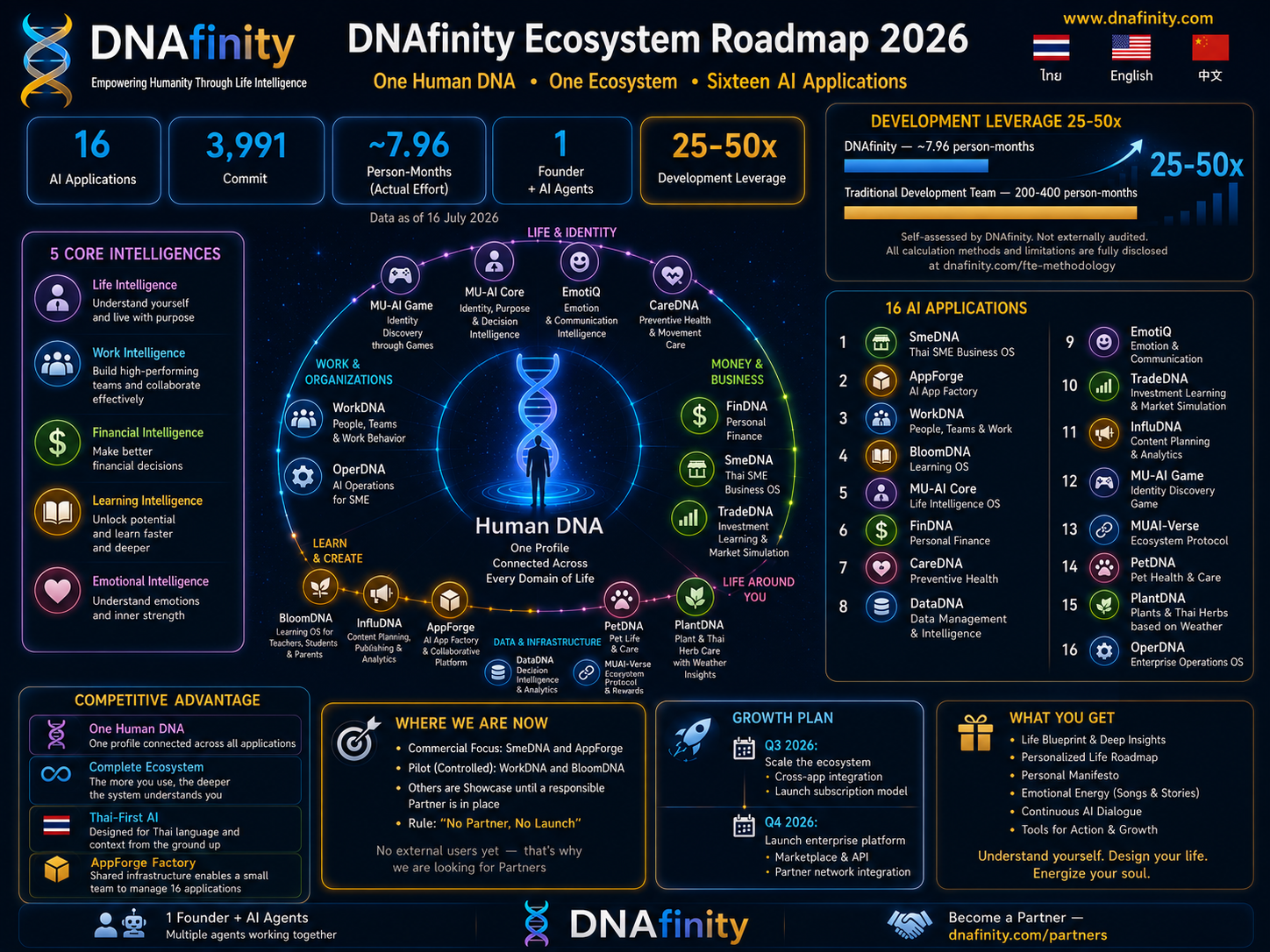
The DNAfinity Partner Program is a business collaboration model for domain experts, technology companies, sales teams, and service operators who want to build a market, serve customers, or extend services around one of 16 AI applications, supported by AppForge shared infrastructure, DNAfinity ID, consent architecture, and L3 technical support.
No partner needs to own every function. Each pilot starts with an accountable owner, KPI, and escalation path.
Bring industry expertise to shape workflows, pricing, compliance, and customer success for an application or vertical.
Best fitOperators, associations, consultants, and specialistsBuild pipeline, run demos and proposals, and close business in a market you already reach.
Best fitSystem integrators, resellers, agencies, and business advisorsConfigure, migrate, integrate, and deliver against acceptance criteria and deployment playbooks.
Best fitSoftware houses, SI, cloud, and data teamsOwn L1 support, onboarding, training, and basic troubleshooting with evidence-based L2/L3 escalation.
Best fitManaged services, trainers, and local support teamsCo-create distribution, research, data, infrastructure, or ecosystem agreements that span applications.
Best fitEnterprises, universities, associations, and platform providersIntroduce qualified customers or opportunities to the team that owns an application, without taking on implementation or support. The lightest entry point before deeper roles.
Best fitConsultants, connectors, associations, and industry insidersReadiness reflects current portfolio governance. It is not a promise that every integration is production-ready.
A Business DNA platform for Thai verticals. Initial needs include gold-shop and retail domain partners, implementation teams, and storefront-aware L1 support.
Lead a SmeDNA vertical
An AI app factory and shared platform for building or upgrading applications. We seek software houses, implementers, and channels serving digital transformation customers.
Deliver projects with AppForge
People Intelligence and team work graph. We seek HR domain advisors, design-partner organizations, and HRIS/SSO integration teams within a controlled scope.
Propose a WorkDNA pilot
Learning Intelligence for teachers, learners, and parents. Schools, teacher champions, and research partners are needed before commercial expansion.
Co-design a school pilot| Application | Focus | Partners needed | Status | |
|---|---|---|---|---|
| MU-AI Core | Life Intelligence | Coach, wellness, strategic distribution | Showcase | Propose a partnership |
| FinDNA | Financial Intelligence | Financial educator, regulated integration, channel | Showcase | Propose a partnership |
| CareDNA | Preventive health | Clinic, wellness center, health research | Showcase | Propose a partnership |
| DataDNA | Decision Intelligence | Data consultancy, BI implementation, enterprise pilot | Showcase | Propose a partnership |
| EmotiQ | Emotional Intelligence | Wellbeing expert, contact center, research | Showcase | Propose a partnership |
| MoveDNA | Mobility intelligence | Transit data provider, mobility operator, accessibility expert | Pilot | Propose a partnership |
| InfluDNA | Creator operations | Agency, creator network, channel | Showcase | Propose a partnership |
| MU-AI Game | Self-insight gaming | Game studio, youth community, distribution | Showcase | Propose a partnership |
| MUAI-Verse | Protocol and rewards | Community, Web3 integration, strategic partner | Showcase | Propose a partnership |
| PetDNA | Pet life | Vet clinic, pet service, community | Showcase | Propose a partnership |
| PlantDNA | Plant care | Nursery, agriculture, Thai herbal expert | Showcase | Propose a partnership |
| OperDNA | AI operations | Managed service, automation, SME pilot | Showcase | Propose a partnership |
A 30-minute conversation to match expertise, market, and application before discussing a long-term agreement.
Define the target customer, problem, scope, roles, KPI, and data boundaries.
Test with a limited customer or use case, clear acceptance criteria, a support owner, and a paid conversion path.
Use outcomes, support cost, and partner performance to decide whether to expand commercial scope.
DNAfinity selects partners against six criteria, and applicants should meet at least four, following the ecosystem's Partner Constitution. Criteria and agreement scope are published up front so every side can self-assess before the first call.
DNAfinity does not open commercial sales for a vertical without an accountable Partner Owner. This prevents selling without anyone to take care of customers — and it is why several applications remain in Showcase even though the product is ready to demonstrate.
A signed agreement specifies role, territory, target, revenue share, support responsibility, data responsibility, IP, confidentiality, exit terms, and non-compete where appropriate. Every term is negotiated on pilot evidence, not vague promises.
We prioritize people and organizations with real customers or networks, industry understanding, an accountable operator, and willingness to measure a pilot. You do not need to cover every function.
No. Domain, channel, and support partners may focus on market and customers. Implementation partners should have technical capacity for configuration, migration, and integration.
No. Revenue structure, market scope, term, and exclusivity must be based on an opportunity brief, pilot evidence, and a separately signed agreement.
SmeDNA and AppForge are the current commercial focus. WorkDNA is commercial-ready and seeking a Partner Owner. BloomDNA follows a controlled pilot path. Other applications remain Showcase until partner ownership, support, pricing, and SLA readiness are established.
Users begin with L0 self-service. Partners handle L1 use, setup, and training; product owners handle L2 defects and integrations; the founder handles only L3 critical incidents and architecture.
No. Any data connection must follow identity, consent, purpose, and audit controls. Joining the Partner Program does not grant access to user data.
We assess six criteria: customer access, time, domain expertise, revenue motivation, support capacity, and measurable commitment. Applicants should meet at least four, and every partnership starts with a controlled pilot.
Specific, concise information helps us assess fit faster than a long pitch deck. Submitting opens your email app with a structured draft; nothing is sent until you choose to send it.