Idea Expansion
Turn a raw idea into a clear specification with scope and product direction.
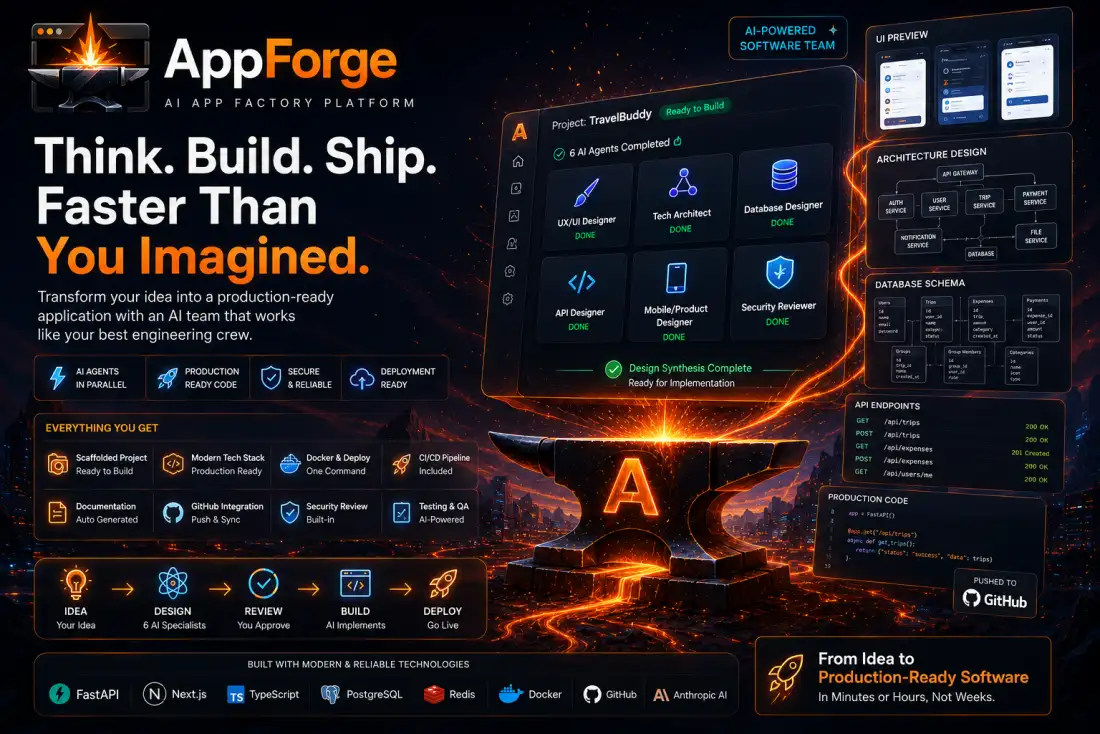
An AI app factory that turns your idea into an application with a production-grade foundation through a multi-agent pipeline spanning UX/UI, development, QA, and deployment. It supports both greenfield builds and brownfield modernization through Reverse Engineer.

AppForge is a SaaS AI App Factory that turns ideas into applications with production-grade foundations through a multi-agent AI pipeline. It expands the idea, designs the architecture, writes code, tests, and prepares deployment. It is more than a code generator: it is an engine for creating an entire product portfolio.
AppForge powers DNAfinity verticals including FinDNA, BloomDNA, DataDNA, WorkDNA, EmotiQ, MoveDNA, InfluDNA, and SmeDNA. It clones a consistent zero-token muai-kit base, streams agent progress over WebSocket, and pauses at human approval checkpoints.
From idea expansion to deployment and legacy modernization in one factory.
Turn a raw idea into a clear specification with scope and product direction.
UX, technical architecture, database, API, mobile, and security agents design in parallel.
Merge designs into one plan and let a person approve or reject it before implementation.
Four role agents — Dev, UX/UI, QA, and Deploy — build the application from the approved plan.
Convert legacy code into the same AppForge standard used by newly generated applications.
Scaffold from zero-token kits so every application begins with a consistent base.
See every agent's progress in real time through WebSocket updates and approval checkpoints.
Download the application artifact or push it back to GitHub immediately.
Anthropic Opus 4.8 leads while Sonnet 4.6 handles worker tasks according to fit.
+ Stack: FastAPI + PostgreSQL + Redis + Next.js 16 · greenfield and brownfield work share one workflow, specification, preview, and handoff.
AppForge runs four connected phases with a human checkpoint before implementation. Agents do the work, while people retain decision authority.
Phase 1 — expand a raw idea into a clear specification, scope, and goal.
Phase 2 — design the user experience and interaction flow.
Phase 2 — define the overall system architecture.
Phase 2 — design the schema and data model.
Phase 2 — define system contracts and endpoints.
Phase 2 — design the mobile experience.
Phase 2 — establish security requirements from the start.
Phase 3 — merge all designs into one plan for human approval.
Phase 4 — Dev, UX/UI, QA, and Deploy agents build the application.
Start with a raw idea for a new app or point Reverse Engineer at an existing codebase.
UX, architecture, database, API, mobile, and security work together with live progress.
The system merges the plan for approval or rejection at a human checkpoint.
Implementation agents build the app, then provide an artifact download or GitHub push.
Turn an idea into an extensible app foundation without forming a full team.
Reduce the setup time for a new vertical from weeks to days with a ready foundation.
Deliver more app projects through one standard pipeline with immediate artifact handoff.
Use Reverse Engineer to convert legacy code to the AppForge standard, then extend it in the same factory.
| Feature | Free | Pro | Premium |
|---|---|---|---|
| Idea Expansion + Spec | ✓ | ✓ | ✓ |
| 6 Parallel Design Agents | Limited | ✓ | ✓ |
| Implementation (Dev/UX/QA/Deploy) | - | ✓ | ✓ |
| Live 6-Agent Progress + Checkpoint | - | ✓ | ✓ |
| Artifact Download + GitHub Repush | - | ✓ | ✓✓ |
| 🆕 Reverse Engineer (brownfield) | - | - | ✓ |
* See the Pricing page for final plan and pricing details.
Yes. AppForge is a commercial priority alongside SmeDNA, and AppForge ID is a verified working OIDC identity provider. Every collaboration starts with a pilot.
No. AppForge uses deterministic, zero-token code generation through a four-phase multi-agent pipeline: Idea Expansion, design agents, Synthesis, and Implementation. It is not an interactive live-LLM coding loop.
The pipeline is designed to produce a production-grade foundation, but the post-generation fixup rate has not yet been measured. We therefore do not claim complete production readiness and state this limitation openly.
Implementation or technical partners who want to accelerate application delivery, especially teams serving customers who need many specialized applications.
If you already deliver customer projects, review the verified capabilities and the measures we have not yet established, such as the post-generation fixup rate, before deciding.